

Featured Social Impact Research
UC Davis MIND Institute
Built by families, for families.
Formed by a coalition of concerned parents, clinicians and scientists, the MIND (Medical Investigation of Neurodevelopmental Disorders) Institute opened in 1998. With initial funding from the State of California and significant philanthropic support, the Institute has rapidly grown into a world-class research center focused on neurodevelopment disorders.
Mission
The MIND Institute's mission is to deepen the scientific understanding of challenges associated with autism and other neurodevelopmental conditions, with a vision to develop personalized, equitable, and scientifically validated systems of support and interventions that help neurodivergent individuals live their best lives
Key Research
- Autism
- ADHD
- Down Syndrome
- Rett Syndrome
- Fragile X Syndrome
- 22q11.2 Deletion Syndrome
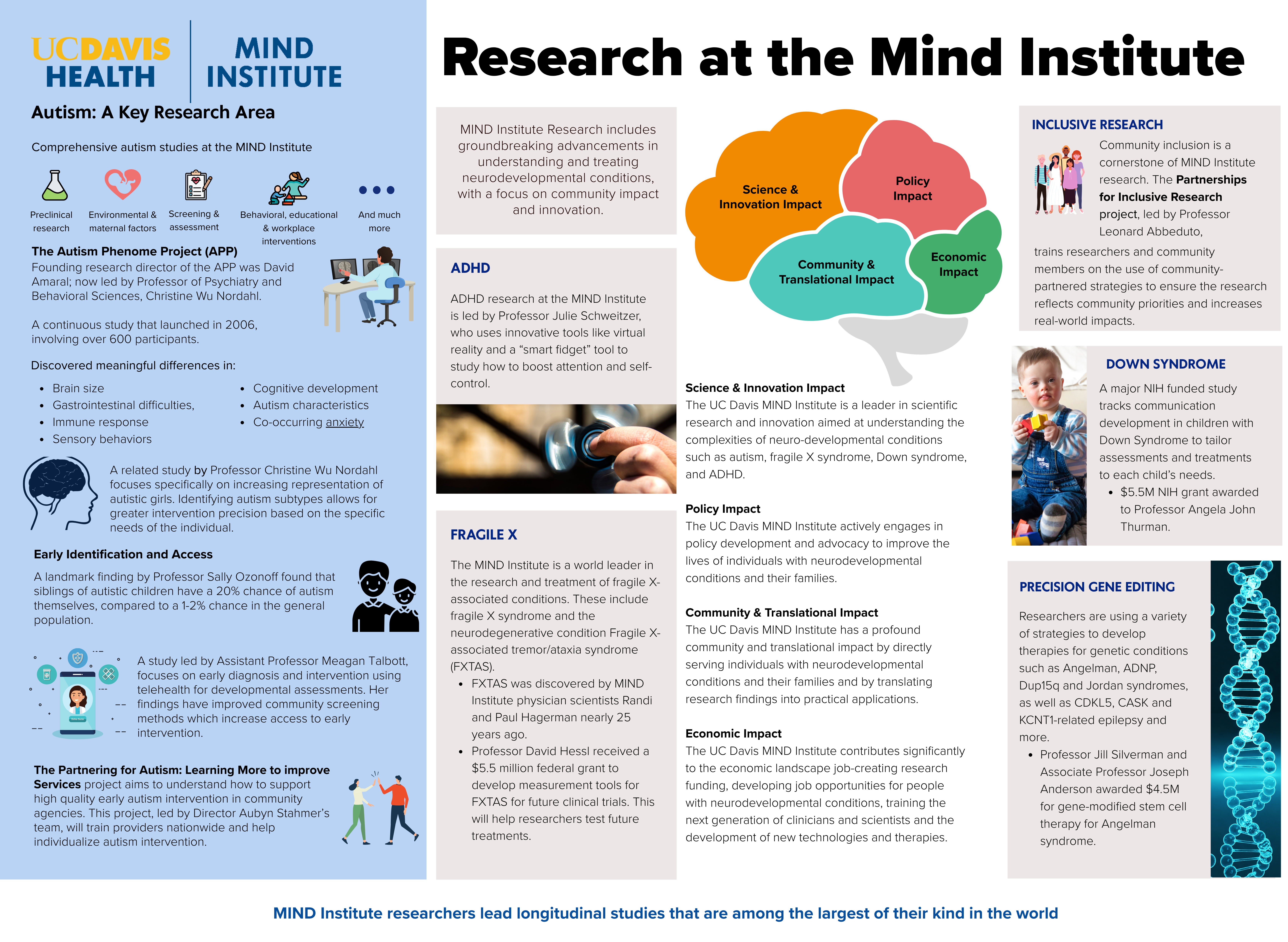
View the full-size, interactive image
Research at the UC Davis MIND Institute
Overview
MIND Institute Research includes groundbreaking advancements in understanding and treating neurodevelopmental conditions, with a focus on community impact and innovation.
Impact Areas
Science & Innovation Impact
The UC Davis MIND Institute is a leader in scientific research and innovation aimed at understanding the complexities of neuro-developmental conditions such as autism, fragile X syndrome, Down syndrome, and ADHD.
Policy Impact
The UC Davis MIND Institute actively engages in policy development and advocacy to improve the lives of individuals with neurodevelopmental conditions and their families.
Community & Translational Impact
The UC Davis MIND Institute has a profound community and translational impact by directly serving individuals with neurodevelopmental conditions and their families and by translating research findings into practical applications.
Economic Impact
The UC Davis MIND Institute contributes significantly to the economic landscape job-creating research funding, developing job opportunities for people with neurodevelopmental conditions, training the next generation of clinicians and scientists and the development of new technologies and therapies.
Key Research Areas
Attention‑Deficit/Hyperactivity Disorder (ADHD)
ADHD research at the MIND Institute is led by Julie Schweitzer, who uses innovative tools like virtual reality and a “smart fidget” tool to study how to boost attention and self-control. ‘
Fragile X
- The MIND Institute is a world leader in the research and treatment of fragile X-associated conditions. These include fragile X syndrome and the neurodegenerative condition Fragile X-associated tremor/ataxia syndrome (FXTAS).
- FXTAS was discovered by MIND Institute physician scientists Randi and Paul Hagerman nearly 25 years ago.
- David Hessl received a $5.5 million federal grant to develop measurement tools for FXTAS for future clinical trials. This will help researchers test future treatments.
Inclusive Research
Community inclusion is a cornerstone of MIND Institute research. The Partnerships for Inclusive Research project, led by Leonard Abbeduto, distinguished professor of psychiatry and behavioral sciences, trains researchers and community members on the use of community-partnered strategies to ensure the research reflects community priorities and increases real-world impacts.
Down Syndrome
A major NIH funded study tracks communication development in children with Down Syndrome to tailor assessments and treatments to each child’s needs.
- $5.5M NIH grant awarded to Angela John Thurman.
Precision Gene Editing
The MIND Institute conducts research in precision gene editing to support future therapeutic development.
Longitudinal Research
MIND Institute researchers lead longitudinal studies that are among the largest of their kind in the world.
Autism: A Key Research Area
Comprehensive autism studies at the MIND Institute include:
- Preclinical research
- Environmental & maternal factors
- Screening & assessment
- Behavioral, educational & workplace interventions
- And much more
The Autism Phenome Project (APP)
Founding research director of the APP was David Amaral; now led by Professor of Psychiatry and Behavioral Sciences, Christine Wu Nordahl.
A continuous study that launched in 2006, involving over 600 participants.
Discovered meaningful differences in:
- Brain size
- Gastrointestinal difficulties,
- Immune response
- Sensory behaviors
- Cognitive development
- Autism characteristics
- Co-occurring anxiety
A related study by Nordahl focuses specifically on increasing representation of autistic girls. Identifying autism subtypes allows for greater intervention precision based on the specific needs of the individual.
Early Diagnosis and Access
A landmark finding by Sally Ozonoff found that siblings of autistic children have a 20% chance of autism themselves, compared to a 1-2% chance in the general population.
A study led by Meagan Talbott focuses on early diagnosis and intervention using telehealth for developmental assessments. Her findings have improved community screening methods, which increase access to early intervention.
The Partnering for Autism: Learning More to Improve Services project aims to understand how to support high-quality early autism intervention in community agencies. This project, led by Director Aubyn Stahmer’s team, will train providers nationwide and help individualize autism intervention.